I wanted to at least produce posts that didn’t revolve around philosophy for a time. For one, it isn’t easy to write about, you have to pick topics that you are at least ok in knowing that you could defend what you say with logic and the second is, if you discuss at length for too long; at least for me, I begin to come off sounding pretentious, which I do not want to come off as or feel as though that may be the case. The truth is I am a human with all the mistakes and faults that come with it, in fact I would say I have some rather unique ones that, with sufficient time, I may divulge later on in a future post.
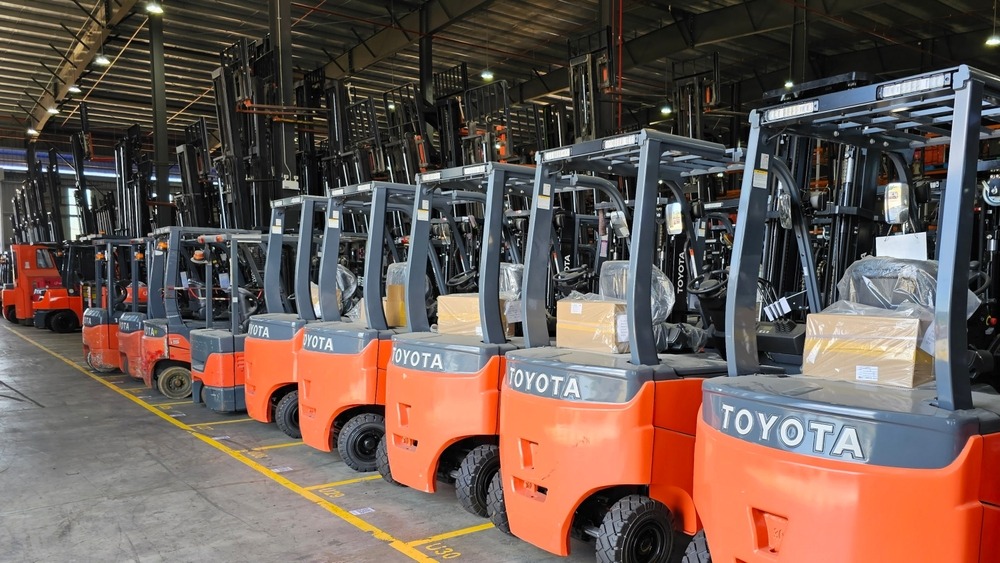
However, today I want to talk about the world of Material Handling and the technicians, such as myself currently, that work on and repair the equipment that make moving a heavy thing from one place to another possible.
When I got out of the Marine Corps I knew that the last career I wanted was Aviation, nothing wrong with the industry itself but after turning a wrench and realizing that none of it matter unless I got a degree in it was deflating to a degree. Another sore point was the volatility. It is a customer centric logistical industry and when demand isn’t there, neither is your job. So I spent a time enjoying my freedom from the military machine and once I realized that I ran out of crayons and no more disability money left that month to buy another pack off the corner of division and wealthy (blacklisted from the arts aisle of Meijer’s) I began to stare my options down hard…either hit up Denny’s with a random set of kids in order to get a fix on the three crayon pack or get a job and hope that Micheal’s doesn’t catch wind of my shenanigans.
In truth, I needed a job. So I worked for Weller Remanufacturing in Kentwood. Great place to start out but it would not be a place I could see myself retiring out of and I knew that then as well. At some point, and yet it still shocks me to this day, my employer allowed me to use a forklift truck to grab transmission cores and rack them as I was responsible for running the turntable parts cleaner for the 1k and 2k GM/Chevy transmissions. I would do that for about 3 months when a random person wearing a different colored uniform asked if I had any known issues with the fork truck. I realized he was the mechanic who would service the machine. I was instantly intrigued with his profession and as he came back with the truck, I started to barrage him with questions. Once I got back to my apartment, I talked over the prospect of changing careers over to a mechanic with my girlfriend (now wife). I realized that the money involved was way better than what I was making and the potential to earn more was also high. At the time, I was making 12.5 an hour and when I got hired by Alta equipment, I made 18 an hour. I would work that job as a Shop Tech. In the service industry of Material Handling, The service department usually has the following:
Dispatcher: They handle repair requests, Work order generation, enter in work order details, track and disburse work orders to the field and shop techs. They may also take on point of sales and other billing duties, which is highly dependent on the size of the location.
Service Manager: They also track work orders but more so from a performance and metric stand point, any remedial or atypical repair issues will be handled by them. The also do quoting and work close with the parts department and other departments to ensure that their department stays operational and the work is flowing. This would also include ensuring that vehicle fleet needs are met, special tooling is provisioned or some alternative is figured out.
Shop Technician: Rental fleet machines, shop related machines (air compressor, power washing machine and more), and any customer owned equipment that requires extensive repairs or repairs that will require more than 2 days depending on environment are handled by this crew. They will often have more specialty tools on hand and other assets that allow them to remove bigger portions of a fork lift that would just simply not be safe or suitable if attempted in the field (such as pulling the transmission and differential as one piece out of a fork truck).
Field Technician: This crews primary function is to conduct planned maintenance and to detect pain points in machine and correct them prior to the machine eventually going into down time. They also perform various repairs where the work is scoped where it is cost effective and trivial in effort to repair. This could be changing brakes assemblies or replacing headlights, seatbelts…fixing horns. They also act as the initial reporter of quoted work destined for the shop, at least some of the time, more realistic it is often the case that they will note a big repair, send it to the shop, the shop will quote and then repair.
At some point I moved to Traverse City and also was able to transfer to the location in that area with Alta. The location there was much smaller and the culture was drastically different. Eventual 18 an hour wasn’t cutting it for me as I went from being 1 of 5 shop techs to being the only shop tech handling a rental fleet, local planned maintenance and customer owned repairs by myself. I felt that was worth a raise and a significant one. Alta disagreed with me on that point and so a few months after, I would leave that job and industry.
I would get right back in with Bell Forklift and I have to say I do enjoy the work. I am very much still a lone wolf in the area I work in but I believe my employer knows that and we keep a rather mutual understanding that as long as they are satisfied with my output and the pay reflects that satisfaction then everyone is ok with the arrangement.
I think one of the interesting parts about the industry is that is neither heavy equipment nor automotive but yet it shares similarities of both. Ever wondered what happened to all those engines that weren’t fuel injected and the EPA outright mandated out of the auto industry? Look no further then in the forklifts because that is where they are for the most part. As of my writing the industry has only recently been solidifying coil over plug and electronic triggered ignition. The gas delivery (LP) still flows through…not port…not direct but through a mixer at just before the intake manifold…so in a way you could call that carbureted to a degree. The industry is a bit slow to flow out tech from the auto industry and the resemblance it takes from heavy equipment is the hydraulic and transmissions. The transmissions on a common forklift is a single speed and back in the day the fluid that was used was J.40 which is a heavy equipment spec fluid for tractors. That has changed and we have begun to see the more conventional AW36 being used. For hydraulics the situation is a bit mixed. Most of your heavy equipment is running nothing smaller that a 3/8 hose or -6 but in my field you can find yourself pressing and dealing with 1/4 hose or -4. The relation actual falls on the cylinders themselves as a lot of the tooling used in heavy equipment can translate to material handling, of course considering you may need some smaller sizes every so often. The going fluid spec depends on the environment but the common is a AW50.
Outside of the combustion side is the electric side which surprisingly actually is rather ahead of the other commercial industries making a break for electrics. Forklifts have been pumping our 24 and 36 volt systems since the 90’s and earlier and there has been sightings of 48 volt systems as well. Some time around 2010’s is when I was introduced to AC systems, as prior to that, everything was in DC. So to see Tesla battery packs and seeing the powertrain on those models, still impressive to look at but it didn’t shock me how they implemented the tech.
Anyway, I really don’t think there is much knowledge value in this post. I wasn’t looking to evangelize the industry or recruit new hires. The industry is niche so demand with jobs can be dicey and dependent on location, but if you do happen to come across a job opening and you feel so inclined, go for it. The field work can be very rewarding and flexible. As for experience, if you have automotive or heavy equipment then you will be a shoe in. Though if you have heavy equipment you probably get paid more than a material handling tech.
Leave a Reply